Showing posts with label community of practice. Show all posts

Wednesday, October 22, 2008

Join the Discussion Workshop

Register here for the Discussion Workshop Blog

This blog on Facilitating Online Discussions is an open circuit introduction to our subject matter. If you are interested in applying democratic forms to community organization, you may register for our closed circuit Discussion Workshop meetings. Expect lots of experimenting with communication and leadership techniques as we build small groups into a unified community.

What's the Discussion Workshop?

In the workshops we meet for short one hour meetings and apply ourselves to learning ordinal forms together. The Discussion Workshop is where we apply all of the ideas and principles that you have read about in the Facilitating Online Communities blog.

We engage in practical dialogue while thoroughly learning the technical and ethical aspects of a given platform.

The Workshop exhibits all of the traditional attributes of a group. Groups are associated into one community through a constitution. Meetings are organized and presented by the members.

A practical workshop

Apply for membership and acquire all of these benefits:

Access to a wide variety of training programs in practical democratic arts.

Attend the weekly business meeting where your voice is heard and you have a right to vote and have your vote counted correctly in relation to a whole number which is the membership.

Serve as an elected officer.

Coordinate workshops.

Simplest way to understand is to think about how you use the telephone and google chat or yahoo or AIM chat. Does everyone talk at the same time? No. You take turns, whether it's 2 people or 20, you take turns.

"Majority rules" is not the foundation for democratic society. In fact, many routine decisions can be made by a majority of a quorum. If a quorum is 50% of the membership then 5 is a quorum of a membership of 10. 3 is a majority of the quorum. Therefore the routine decisions are made by 3 of the 10 members. While minority rules in small matters, it is desirable to have a majority or supermajority in matters of greater weight.

Our organizing principle will not be topical but temporal and ordinal. So accept that we will be topically disorganized until we establish the temporal and ordinal features of our forums. Ultimately, the membership will be responsible for topical organization.

Since I believe that the personal privacy of individual members is more important than the security of the adm or the posts, I have opted for restricting the activities of the adm. That's how I arrived at the above formula. I want to set up forums that are rooted in equality.

We are going to use a large number of forums and boards that are each set differently to achieve a certain texture or democratic principle.

Member administered programs

Tuesday, October 21, 2008

Writing the Rules

Rules restricting the powers of administrators and moderators help foster an atmosphere of equality. The personal privacy of individual members is more important than the security of the administration or of the forum content. I have opted for restricting the activities of the administrators. That's how I arrived at this basic formula:

No rules for the public

Few rules for members

More rules for moderators

The Most rules for administrators


With this formula we may achieve balance between the powerless and the powerful. Since we are going to curb the powers of the administrators in order to produce Equality, we will need to begin by making our first rules for them. We have turned the formula for rule making upsidedown.

Let's build some practical and accessible models that any web community member can use for experimenting with and learning all of these principles. Our task will be to balance and preserve the basic principles outlined in the previous sections to achieve unity of purpose, equality and freedom of expression. The heart of our community will be The Discussion Workshop Modules, a progressive skills building program that treats the discussion as an art and a process.

We will usethese free boards this reduces risk tranfer the adm over to elected official

Apply to phpBB2 phpBB3

Since the admministrator needs the most rules we will focus upon that first. Our second priority will be the rules for moderators. Our third priority will be rules appropriate for the general membership. Rules for the public are of zero priority because the purpose of open circuits is to make contact with the public. We will not moderate the public in any way but simply allow the public to qualify themselves for membership. The membership will select prospective new members from the public.

The first restriction is that the administrative account must only be used for an administrative action. The Administrator account is a tool and is not to be used for posting in discussions. It is reserved for member approved administrative actions only.

We will use the circuitry to include posters as they establish themselves into the membership. Open circuits and closed circuits allow us to regulate access. Rather than invite the whole world in and then take a negative approach of excluding people either by arbitrary administrative action or the so-called "democratic" method of voting posters out, we will use an inclusive approach.
Let's set up the first forum Open Circuit Guest Forum

An open circuit phpbb2 forum

This setting allows the public to moderate. Anyone can delete or edit a post. Members, mods and adms are not able to delete or edit while logged in. They must log out and perform an edit or delete as any other guests.

Furthermore, we have added these rules and permission settings that apply to adms, mods and members but have no affect upon the public.

1) Members, moderators and administrators may not post, reply, edit, delete, sticky, announce, poll or vote in the Open Circuit with logged in accounts, are limited to the permission settings of the Open Circuit forum and may post, delete, sticky, announce, poll or vote in this forum only as Guests.

2) Moderators and administrators may move, split, lock and delete threads in the Open Circuit only with the approval of the membership.

Note that these rules are very brief and they apply to behavior of the fewest, since they apply to the fewest, they are most easily implemented. They are also very objective and do not in any way deal with the "morality" of a poster. Discipline is administered first, to adms; second, to mods; and lastly to the membership. At no time are we concerned with the behavior of the public on this circuit. The purpose of an open circuit is to allow the public an entry point for the public to interact with the community.

Open circuit phpbb3 forum. The setting here allows only the public to view the forum. When a member, mod or adm logs in, the forum disappears from their view. This makes it impossible for an adm or mod to check any IP numbers assuring maximum privacy. No one but guests can post a new topic or reply.

In each of these two examples, we have realized the basic democratic principle of Equality.

Guests, Members, Moderators and adms must meet on equal footing. No one is armed against another. No one is capable of infringing upon the privacy of another. No one has any greater right or responsibility than another.

Next, we must qualify the membership. We qualify them by giving them rights and responsibilities. They maintain their rights by fulfilling minimal responsiblities. these are the rights and responsibilies of a discussion participant. The Discussion Workshop gives the community experience with posting in form as an organized group rather than a collection of individuals. The Workshop modules are presented as a series of projects by and for the members themselves. The projects are designed around self-moderating democratic principles or discussion forms. Each participant gains valuable experience and exercise with basic rights and responsibilities.

Right to speak

Right to hear and be heard

Responsibility to respond

Responsibility to listen

The Discussion Workshop consists of a series of modules. Each module consists of a set of 3-5 projects that have specified objectives and an assigned Evaluator.

It would be good if each project (including evaluation) could be completed in a two hour session.

Basic Posting Workshop Objectives

    *To bring together the collective knowledge of all participants concerning basic posting skills and thereby increase the knowledge of each individual.

    *To verify that the membership has achieved an increased understanding of the basic posting skills.

    *To qualify the prospective member for DUN membership and participation in the Discussion Workshop Series.

Now that we have a membership, let's set up our next forum. This one will admit posting for Guest and Members together.

And these are the rules and permission settings:


1) Moderators and administrators may not post, reply, edit, delete, sticky, announce, poll or vote in the Guest/Member forum with moderator or administrator accounts, are limited to the permission settings of the Guest/Member forum and may post, reply, edit, delete, sticky, announce, poll or vote in the Guest/Member forum only as Guests or with logged in Member accounts.

2) Moderators and administrators may move, split, lock and delete threads in
the Guest/Member forum only with the approval of the membership.

Again, note that we have made no rules for the public. The best thing about these rules is that new people don't need to know anything. The rules don't apply to them.

The members have the ability to delete when logged out yet they gain immunity for their own logged in posts. Guests can bridge the inequality gap here by becoming elected members. This is the most practical way to govern a community. We want to achieve a state of equality between all members.


Guests can have posts and threads qualified for saving. Guests can establish "Relative Identity"


member selection election is responsibility and right of the membership adm not allowed to interfere in process
adm has one member account for voting and posting equal to any other member
as community grows we will apply greater restrictions upon adm
restricted times means not lollygagging at IP checker
must prepare adm actions in advance and schedule
disciplined discussion

Unity of the Whole
Equality
Privacy
Purpose
Membership
Rights & Responsibilities
Freedom of Speech
Roles - Taking Turns
Objective Evaluation

deletes bans reduce credibility

adm as trustee never posts but is keeper of the keys

rational discussion is in form

open circuits random posting in unlimited numbers is good for chat

closed circuits with limited numbers using ordinal and temporal form for rational discussion measured discourse.

We are going to use a large number of forums and boards that are each set differently to achieve a certain texture or democratic principle. It is possible with our system that someone could "sneak" another account into the forums. But to do so they would have to "purchase" the account by assuming the basic responsibilities. Also with our system, they must advance and assume more responsibility for each account or the account will become inactive.

Rocky Forum Picture Show

Imagine that you have been invited to join a discussion group or community. The community has no designated time to meet. People come and go whenever. Sometimes there are a few together at the same time but everyone talks at the same time. No one gives any indication of listening.

Language is an issue. English is not neutral and puts non English speakers at a disadvantage. Participants should be multilingual at least bilingual.

Inequality does not exist among race, gender or sexual orientation because of anonymity. However, there has been created a new inequality between those that have power and don't have power - the moderators and the trolls. The trolls are supposed to be disrespected.

Does not mean that taking from those who have earned and giving to those who have not earned. Everyone may not finish the race at the same time because some may run faster than others. There is a principle of liberty. You are responsible for yourself and the outcomes that you mean to attain. You deserve to have what you have earned. You don't deserve a voice just for showing up but for producing equal benefits for the community along with your fellows.

The gap between administrators and members is too wide. We can probably agree that administrators have ALL of the power and members have NONE. The following is a compendious list of everything an administrator can do and everything the member cannot do. Make any and all rules Edit without leaving a stamp.

Edit their grammatical, rhetorical and logical presentations after the fact, leaving the impression of clean, fluent, sophisticated and intelligent posting. The regular poster leaves evidence of editing on the post. Either everyone should be able to make clean edits or everyone should leave a chunky edit stamp with an edited post.

Delete a post (their own or others, fabricating an intelligent presentation of their own selves)

Delete a thread Lock a thread (if people are overly interested in it)

Assign modships (to many anonymous persons who then have unequal status and powers)

Delete an account

One look at the administration panel of any message board and you'll be convinced that a huge inequality exists. When a member edits a post they leave behind a big chunky edit thingy like so: Last edited by Chooseboogers on Tue Sep 11 2007 939; edited 1 time in total In contrast, the administrator can edit and leave a clean post. They can also edit any post on the board. A member cannot. An administrator can delete anything but a member can't.

The cards are all stacked in favor of the administrator.

An adm can check your IP and invade your privacy while protecting their own. Read an IP number Look up an IP number Block an IP number Contact you personally (if they find you to be troublesome)

Gather personal information on you Now think about it. Why would I want to converse with anyone under those conditions? Why would I speak with a person who could shut my mouth while I have no power to do the same to that person? I reject the proposition outright. No wonder there is so little genuine communication in these "communities"! It's like sitting at a round table discussion in handcuffs while your mates are armed with ballbats just in case you should "act up"! There can be no real community where there is no equality and since the nature of the forum set up is so unequal...

...what's the solution? You can either expand the powers of the members or restrict the power of the administrators. Restricting and disciplining the administrator is the better option. The best option may be a balance of both. We want to achieve a state of equality between all members. The administrator can be restricted to posting only with a regular member account. Further restrictions can limit the times and frequency that the administrative account can be logged in , and for what purposes. A schedule may allow the administrator to log in once a week or once a month for a limited time, for the purpose of completing any tasks that the membership has assigned.

This protects the privacy of all members since the membership no longer stands transparent before the administrator.

IP checks And there is a "moderator". The moderator has the power to shut your mouth, change your words, change their own words without any trace of having done so. You are given documents to read while the moderator reads over your shoulder. The moderator also has access to personal information about you. They can learn what town or region you live in without asking. You cannot withhold this information. They can trace your number and contact your employer or family. You have no privacy. You must relinquish all rights and give these rights to the moderator in order to qualify for participation. You do not have any right to know the same things about the moderator that they know about you.

Only need to know that the other person is not yourself. Beyond that is invasion.

The members are equal to the purpose by way of the programs that enable them to achieve the community objectives.

Why do people visit forums? To interact. Not to read or to write. We want to select those poster who are qualified for discussion.

The members are here because of the community. They did not gather here to meet the administrator. An individual is not to be treated simply as an instrument to promote someone else's purposes,??? whether that purpose is to sell or promote the purpose of one individual.

Therefore, it has a natural tendency toward the dramatic mode and the dramatic mode depends greatly upon the development of conflict.

link to samples

model forums guest posting php2 who gets disciplined for posting in guest forum? members mods and adms not public
php3 adm and logged in members can't even view the forum impossible to IP check
consistency of language use of words like member guest forum discussion democracy
finally a positive approach to web community discussion
delete and ban reduces credibility

I was not given any responsibility to qualify me for a discussion. Not any responsibility that could be objectively evaluated.
"Be nice" is not a behavior that can be objectively evaluated.

There are no spies and no spying
The public rules on open circuits and members have right to closed circuits only

took the "standard" and turned it upsidedown and insideout
eCommunity consists of anonymous parties eFriends who never meet because it is impractical
ideal eCommunity of 10 would be one from each of five continents and 5 from several planets.
This is the eCommunity,the eDemocracy that we are planning. It's purpose is NOT a regional gathering.


other set ups phpbb3 with member registration use "Non- voting Guest" rank for 1 post Elected members automatically get Non-IP-checking Mod staus for purpose of moving and deleting give maximum control to membership

Begin with a suitable platform
email
gmail chat
gmail group chat

The group chat feature lets you chat with many friends at once. There's no limit to the number of people you can chat with, and any participant can invite others to join. To get started, follow these steps:

  1. Start a chat with a single person in your Contacts list.
  2. Once you've started the chat, click Options at the bottom left of your chat window and select Group Chat.
  3. In the field labeled 'Add a person to this chat,' enter the name of the contact(s) you want to add to your group chat.

To end your chat, click the X at the corner of the chat window. Others in the group chat will get a message saying that you've left the conversation. If you want to rejoin, you'll need to be invited back by a contact who's still in the group chat. The group chat will continue until all participants have left.

Register here for the Discussion Workshop Blog


Sunday, September 28, 2008

Finding a Buddy

I want to begin writing a project outline for a discussion series to be administered by the community called Discussion Workshop. The concept is that all information should be imparted through discussion form and experience, rather than FAQ's and links only. It follows that the first project is Finding a Buddy. So I would like to discuss with a buddy about how to find a buddy.

So there are a few people I have connected with a bit here, but what is a buddy? I think of a buddy as someone who is dependable, someone I have a sustained relationship through a series of conversations. A buddy is someone who shares at least some of your own values with you. Like Joy and I share some of the same ideas.

What else? Maybe someone who appreciates your style of communication?

How to go about finding a buddy? I don't know if you can actually find one. All of my buddies have just come along in life. Still, I do think it helps to actively look for people because it increases the chances of finding quality people. In the Discussion Workshop, I would like to see the community acticvely pursuing the "Buddy System" as Derek calls it. I can see it as an assigned project to find a buddy and even having an elected official like a Master Host who develops a Buddy Program.*

Once every person has a buddy, I can see people imparting the needed information about technical aspects of platforms and the forms of discussion that can make a coherant community.

I would like to go through a complete series of discussions like we have done in this foc08 course. Each disculd focus upon an activity to experience together.

Basic Module 10 projects (choose from options)
Finding a Buddy
Choosing a Platform
Clocks and Time
Arranging Appointments
Chat through a Window
Practical Dialogue
On the Same Page
Alternate Posting
Choosing a Topic
Quoting the OP
Your First Circle
Evaluate a Discussion

By the end of this module, we will have formulated a small democratically organized group. I would like to constitute the groups and bring them to about 20 members then some of the original nucleus will organize to start a separate group with the same constitution. This allows each person to be a measurable part of a whole group that is possible to listen to. We might even call it "The Listeners Club".

*I am not saying that there is a prescription for finding a buddy, as I know from my own experience that buddies come along out of nowhere. But on further consideration, maybe they don't. I have to experiment with many different people to "stumble" upon one.
>My Take on Facilitation
I want to help people to learn through self-teaching dialogue how a community may facilitate itself through proper applications of traditional democratic arts and skills.

Tuesday, September 16, 2008

The Listening Experience

How big should community be? It seems to me that those "communities" that people feel are real communities are those that attract the most people. But are lots of people neccessary? Or should we encourage a small group that is listenable?

A group should be no larger than a number that can be listened to and heard! The best group size depends upon where the community is going. But size has an effect upon the results. Three to five is good for some things while seven to ten may be better for others. I think a small group could be large and listenable at twenty members if they are fully trained in all basic ordinal forms.

Traditional communities like Rotary International have over 1 million members worldwide yet they meet once or twice a month in small local groups of 10 to 20 members. They have 32,000 clubs that are unified in purpose through a constitution.The clubs are divided according to geographical limitations. The advantage to the small group is not that thousands of voices can be heard but that the mebers can have a better listening experience. The Internet does not suffer from information overload but people overload!

So imagine one community that is divided so that there are only a listenable number of members in each group. If this plan were to be transposed to the Internet, where would the natural divisions and unities exist?

Listening Roles
I think it's important to ask questions to verify whether our assumptions about people based on their posts are true. Reacting to what someone says without knowing what they mean may breed and feed all kinds of emotional baggage. Is this what we want in a discussion on facilitation? For example: I think I should have asked questions instead of backing off when the language got unpleasant for me to verify what the other person had in mind when using what I considered bad language. Perhaps, it was the person's normal way of talking. I should have verified things before coming to any conclusions
I'm learning...
Nellie


This is a good reason for people to regularly perform listening roles, so that understanding can be assessed and verified. Such listening roles such as Role Reversal in dialogue or debate, taking turns in each project. I envision a project in Concessions, learning to see what is right about an opposing argument.

A Listener's Club might aim to promote these rights and responsibilities in each practiced project:

The right to speak.
The responsibility to respond.
The right to hear others speak.
The responsibility to listen.


The discussion form serves as a model for a group. We begin practicing for community and grow a community up with the building blocks of the discussion form itself.

Next: Learning Ordinal Forms


Learning Ordinal Forms

I'm thinking about my early learning of ordinal forms and smile at the memories of playing with the other neighborhood kids as a child. We all learned ordinal form together from the older kids in games that we played. We would each put one foot into a circle formation. Then an appointed counter would touch each toe counting arond the circle of shoes or barefeet saying,


"Eenie meenie miney moe
catch a monkey by the toe,
if he hollars let him go
my mother said to count to ten
1 -2 -3 - 4 - 5 -6 -7 -8 -9 -10"

That was our early training in democratic form. A kind of lottery with luck to choose the order for the game. It also cued us that there was such a thing as ordinal form, which served as a foundation for all of the games that we played. The most important issues in playing these games were of order and position. Who is first? And who is "It". Tagging someone and calling "It!" was an official cue for a running game. "It" had to run after you, following where ever you led, catch up to you, tag you and call "It!" This cue reversed the position and order. This was our first experience with the democratic principle of "taking turns" or what we adults call - roles.


Now that I look back on those early experiences with ordinal form, I realize that democratic procedure is only role playing in the expository mode.


I'm wondering how to get people involved practicing democratic procedures in the form of games. I am not interested in push button democracy, so no computerized games. Democracy is a human endeavor. To computerize it is to trivialize it.

democracy games put hand on bat next hand up to the knob of the handle last one grips the knob wins
lottery everyone launch a post at a given minute first or last to get a post stamp within that minute wins gets to post next OP or lead Evaluation Team
open circuit games spamming games for kids most active spammer wins

Connectivity
serendipity good for individual growth but not community it's anti community
My Take on Facilitation
I want to help people to learn through self-teaching dialogue how a community may facilitate itself through proper applications of traditional democratic arts and skills.


Monday, September 8, 2008

People Need Training

Forums, chats, blogs, conferences, I look at all of these items as power tools of communication. In order to communicate we need to know how to operate the tools. They are not simple hand tools, they are capable of hurting people if we don't know how to use them. They are capable of causing just as much miscommunication as communication.

I wonder if anyone out there would agree with me? Or do most people think, "It's just a forum, I can stumble around through it and pick up what I need to know. If I don't know it, then I probably didn't need to know it".

I used Phpbb2 for five years and thought I understood it. Then one day I challenged myself to sit down and click every link on every page and ask myself "What does this do?, what does it not do?, what do I know?, and what do I not know?"

I was surprised to learn how much I didn't know. I calculate that I understood about 20% of the forum functions! And in all those five years I thought I knew something! So maybe, just maybe, I am dumb about the simplest things. But, hey, is there some reason for us to assume that everyone who comes to our community today understands the simplest things? Like how to make bold or italic fonts in their text?

No! There is absolutely no reason for any such assumptions. Let's assume that people know nothing and that they also know something. So let's find out what it is so that we know and don't know so we can fill in gaps and increase the collective knowledge of the community. I'm not talking about a thread. I'm talking about a committed group who meets at a specific time for a set period of time to investigate fully both it's knowledge and ignorance. That's a practical workshop.

So that's why I am looking for buddies who would like to make a commitment to learning all of the functions of simple platforms like gmail chat, google groups, blogger etc.

I think it would be nifty to have a Links Club, when, weekly, the members rotate the role of bringing in one link and all of the members go through each of the page elements and links on the page and learn it together.


Friday, August 29, 2008

FOC, Course or Community?

I was very careful about beginning this course. I came in on the day that it sterted and figured that was too late. Also there were over 100 "members" signed up. I thought that the number was way too many. I was going to suggest to Leigh that I wait for the next course out of respect for those people who had already begun. I also was going to suggest a much smaller group for the next FOC, if there was one.

Then as I began reading along with the course, I noticed that a huge percentage didn't follow through, so I signed up with a dedicated FOC08 blog becuase I thought I could meet the commitments.

To facilitate or to teach
"But I have been asked to facilitate a learning community"
What community? I thought that this was a course?
For me the FOC community is the course. This is what brought my attention to the community. I call it a community because those who were in FOC07 are still here. I am glad that they are here and seem to be establishing a community but it would help me straighten out my tremendous confusion by marking with some distinction the roles of FOC07 and FOC08.

I know what I am. I am FOC08. I have an FOC08 blog and it connects to every other blog. The course outline is in my sidebar and my post either complete the assignment requirements or are preparatory work for future assignments or are concerning web community organization.

I am FOC08. What I want to know is who qualifies for the FOC08 group with me? I don't think that it is fair to allow anyone else to traipse in here with any kind of equal voice just by setting up a blog. This is a whole course and I want to finish it with committed people. I want to trim my blogroll down to those who are fellow FOC08.

The other question is the FOC07 people. What role do they play? My feeling is that if they are not on this course with me, then they should be developing an advanced course that supports this one. They should organize to participate in whatever projects FOC08 brings in and help evaluate them according to objective criteria the FOC08 establishes for each project. If they can do this then they are part of FOC08. If not, then they are still a part of our community but should not be in the course because it only adds to the confusion.

I also want to have a closed circuit just for those members who are on either course with no more people traipsing in. As a member of FOC08, I think I have a right to the best conditions. Just as in a university course, we need a decent room, with comfortable seating, lighting and ventilation. We also would need a door so that we could conduct our work undisturbed. I require the proper conditions to continue.

Register here for the Discussion Workshop Blog


Wednesday, August 27, 2008

Facilitating, Moderating or Teaching?

In this course on Facilitating Online Communities we have come to "facilitating, moderating or teaching". To facilitate we must have some overall organization, some system or path laid to help people move together. Anyone can lay their own individual path but if we are to walk together on a shared journey we must use a common route, such as a course outline.

In order to make the journey, it may be required to have certain tools and skills. In teaching and learning these skills, we develop coordination as a community. I think of this aspect as a disciplined effort as if we were going to play on a ball team and needed to learn the skills and coordination necessary for throwing or kicking a ball through the goal.

The traditional democratic skills of moderation are needed in times of conflict.

In all these instances, we humans have a complete ready-to-use set of traditional democratic arts that we can apply once we learn and know them. Throughout this course, I am going to continually be looking to our common traditions for solutions.


Monday, August 25, 2008

Traditional Community

How did traditional communities like Rotary International manage to grow their memberships to where there are more than 32,000 clubs and over 1.2 million members world-wide? They put the web community to shame!

They did it locally, building small groups one by one. The web has plenty of small groups but no system for self-propagating them.


The world's first service club, the Rotary Club of Chicago, was formed on 23 February 1905 by Paul P. Harris, an attorney who wished to capture in a professional club the same friendly spirit he had felt in the small towns of his youth. The Rotary name derived from the early practice of rotating meetings among members' offices.

Rotary's popularity spread, and within a decade, clubs were chartered from San Francisco to New York to Winnipeg, Canada. By 1921, Rotary clubs had been formed on six continents. The organization adopted the Rotary International name a year later.

As Rotary grew, its mission expanded beyond serving club members’ professional and social interests. Rotarians began pooling their resources and contributing their talents to help serve communities in need. The organization's dedication to this ideal is best expressed in its motto: Service Above Self.

By 1925, Rotary had grown to 200 clubs with more than 20,000 members. The organization's distinguished reputation attracted presidents, prime ministers, and a host of other luminaries to its ranks — among them author Thomas Mann, diplomat Carlos P. Romulo, humanitarian Albert Schweitzer, and composer Jean Sibelius.


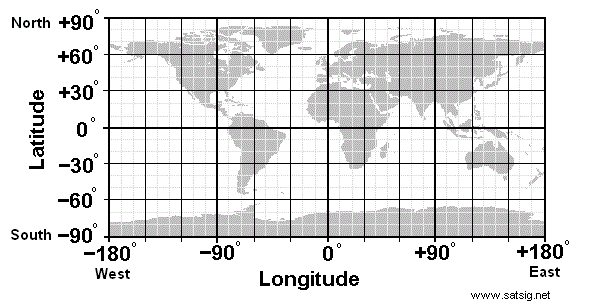
Latitudes and Longitudes

Each quadrant equals 30°

A given latitude at the equator extends from 0° to 180° (either W or E) with two posters on both ends. A given longitude (0°) equal to the latitude and extending from one pole to the other with two poster at both ends. The conscious day begins for all four with the two posters on the latitude exchanging posts between each other and the two posters on the longitude exchanging posts. What is the relative frequency of the posting cycles on each line?

I say that given any two longitudes and latitudes of equal length (or arc), with two posters posting between themselves from the extremes, that the two posters on the longitude will have a higher frequency of post exchanges between them throughout a conscious day.

On the map, place two posters at the extremes of a longitudinal area. Place one poster at the tip of Cape Horn, South America and the other poster in New Brunswick, Canada. Place two other posters at the extremes of a latitude equal to the length of the said longitude, one at London, UK and the other in Irkutsk, Russia. All other factors being equal (purpose, interest, speed of connection, etc.) the two on the longitude will have a higher frequency of exchanges than those on the latitude.

Let's form two groups of equal numbers and spaced evenly apart from one end to the other, one group on the longitude and the other on the latitude. The group on the longitude will have more opportunities for exchanges and will have more options to organize temporally and ordinally with greater facility than the group on the latitude.

What is the "comfort zone" of any one poster? If I live in one time zone, the further away another poster is from that zone, the more inconvenient it is to meet together. I guess that, of the 360º on the globe, the comfort zone is just about 180º (90º on either side of the longitude I reside upon). The window begins closing then.

120º allows a greater window of opportunity for meetings. I can divide the 360º of the entire globe into three zones of 120º each, and I will call them:


  • The Americas

  • Europe, Middle East and Africa

  • Far East and South Pacific
  • The geographical distribution is incidental because anyone sharing the same conscious day with a zone is qualified for membership in a group in that zone.

    In this blog, I am treating time as if it were a geographical limitation. If I do this, I can easily translate the organizational structure of the traditional service club to online communities of practice, with democratic forms fully intact. Nothing need be lost.

    MORAL OF THE STORY: Think Globally, Act Locally.
    Large clickable detailed world map 2.3MB with cities, longitudes and latitudes.


    Sunday, August 24, 2008

    What is Community?

    Even though we need to move on with the course outline, I am pretty sure that when the course ends it will all come back to this question of "What is community?"

    Amy Lenzo says in Community and Technology


    I mention beauty in the sense of an attractive aesthetic, yes - I'm a big believer in the power of line and space and color - but equally in the sense of kindness and care for the whole, creating a psychologically "safe" space in which people feel free to speak up and know they will be listened to. A space where they can easily find the tools they need to use and feel confident in using them. A space where all can feel equally valid and important to the whole. Having a buddy system can help with this, and that idea came out of this group quite organically, which is great.


    I believe that a sense of belonging can be ensured in smaller groups where we don't have to compete to get a voice. You know that at a meeting of ten or fifeteen people, that you are going to be heard. I also hear what you are saying about the "whole". A community should have integrity of the whole. We should always be able to count the membership on our fingers and toes and say - There are 15 members, therefore a majority (relative number, relative to the whole number which is the membership) is 8! We should be able to count relative quantities at any time because we know the whole number of the membership. Without a whole number we can hardly calculate relative quantities.

    Community is not about technology, it's about people, and when the focus of the conversation is too centered on the technology it draws attention and energy away from the whole and our ability to create or facilitate community together.

    Yeah. Give me simple, common platforms like email, email groups and group chat and give me a handful of people who are committed to preserving and promoting traditional democratic forms and you can have all of your exotic technology. I know which group is going to produce the best ideas. It won't be the ones with the high falutin' technology. The Internet is a testimony to that fact. The technocrats have given us poor forms for human organization. But it's not their field. They are not trained in Ethics, History or any of the Liberal Arts. They are technicians, kind of like TV repair people.

    Derek says:

    I like the term free range learning. What will benefit us all a lot is if buddy groups actually sprout up.

    I like the idea of a buddy system because it gives established members a role. If there are members of FOC07 hanging about in the FOC08 course, then I think they should have definite supportive roles. If they are not blogging through the course as full participants then they should have definite "Buddy" roles to help assist us in organizing our projects. FOC07 should be recognized but not allowed to interfere with the ideas and experiments brought in by the FOC08 group. Giving them secure roles is one way to reassure everyone.


    Leigh says:

    If we were to go back to a traditional understanding of community and ignore for a moment what Wenger has brought to the word (i.e. "Community of Practice"), how might we think of an online community differently? Would it be different if we had children and teenagers in the community for example? In this sense, how many of us have really been a part of an online community?

    In a traditional community there is usually an age restriction of about 18 years for adult groups. And I've never heard of mature adults joing the Scouts. Those are childrens groups. Even within that one group, the members may be further subdivided. However, I can't imagine applying that because we are not building private clubs online. A private club does not broadcast it's business to the world. I go to a club and it's closed. People don't wander in and out and pop in to cast a vote and disappear like they do on the web. When you broadcast your proceedings to the world, I don't think you have any right or obligation to verify anyone's name, rank or serial number. People prefer anonymity and they have a right to it as a matter of privacy.

    Anyway, I think Nancy mentioned in another blog about "How do you filter?" I'm interested in finding objective ways to evaluate all aspects of community. For one, I would like to address how we can filter people in without comprimising privacy.

    Amy Lenzo says:

    I'm not sure that having an age range makes sense to me as criteria for defining community, but I do agree the term is used far too loosely these days - sometimes in ways that feel strange, even false, to me.


    Wednesday, August 20, 2008

    Mini-Meetings

    Deb posted on her blog, mediateachspace:

    "I'm also not coping well with where abouts to air some of my comments. If one person publishes something that I'd like to comment on, and then someone else says a similar thing on their blog - how do I make the connection between those two people (and I may be the only link between them)"

    Leigh closed the last meeting by suggesting that we also organize our own 2 or 3 person mini-meetings about the course. This is a good idea for people who need to connect the dots from one blog to another. I would really enjoy that. And remember, if we are going to have a great conference, we have to begin planning for it now, so let's start forming those groups. We could use the new GroupChat function in Gmail. Leave a note here on this post.


    Tuesday, August 19, 2008

    Notes on Meetings One and Two

    (This is a post I began when listening to the first and second meetings but didn't publish. Dated August 19. The reason for the post was to give verifiable evidence of my listening to the two meetings.)

    I define a "meeting" as a gathering of people in temporal and ordinal form. The most encouraging aspect of the two meetings that I have listened to was the adherence to some temporal and ordinal form. It wasn't just a batch of random. The meeting was centered with a leader as a point of reference. Leigh led everyone through introductions. He had an alphabetical list and called off the names which gave cue to each member of the meeting. Whenever a member wished to speak they gave cue to Leigh by raising of hands. I don't know what that is in elluminate, probably some visual smilie that you use to signal the group.

    12 participants:

    Leigh
    Bee
    Daryl
    ElderBob
    Greg
    Jeffrey
    Mary
    Nancy
    Sarah
    Sean
    Vida
    Violeta

    Because there were clear temporal limits (one hour) the meeting moved ordinally through the agenda. What I like about ordinal form is that it allows members an opportunity to fulfill their rights and responsibilities to speak to the group.

    At one of the meetings, someone put a picture upon the screen which blocked the agenda that Leigh had made. I found that to be annoying. I would have rather seen the agenda.

    Splitting the meeting into two sessions was a great idea but I think that there should be two facilitators, possibly an assistant, while retaining Leigh as the overall course leader. This way people know that the meeting will happen. The attendance of this meeting was slightly lower and I wonder if the missed meeting was a cause?

    I wonder why only one session is posted afterward? With each meeting of two sessions, there should be four sessions posted.

    I liked listening. It sounded like a verbal summary of what is being blogged. However, I found myself doing a bunch of other tasks and not really paying attention. I was kind of like reading online. I don't really read very well online. It's more like skimming, not attentive reading. It's like that with the blogs. At least I know it, so I just keep going back and reviewing what strikes my fancy. It takes several readings to scratch the surface of some of these blogs.

    I also noticed something that ElderBob said about people gathering from different regions and times. Ha! I am blogging alot about organizing around time zones and this jumped out at me. Talk about people only hearing what they want to hear! Well, that's the way I listened to the meeting.

    ElderBob also said something like "traditional communities were established on a rail line or waterway, along a common line". I thought that was interesting. people once had physical connection. I ask myself "What common lines exist now?" I think that there are some physical connections

    ElderBob also said that "you can be a member of many communities". OK. I can buy that to an extent but I can only absorb so much. Offline, I can become a member of so many communities but not an unlimited number. Likewise we should remind ourselves that communities don't function when there are unlimited numbers of members because an unlimited number is not able to be counted and no rational discussion, deliberation or debate can take place (with the exception of very small groups of about 5 to 7 members). But in any case, a whole number is necessary if we are to calculate any relative quantity such as equality, majority and minority.

    Bee: common ground

    EB: Not geographical but mindset

    Artie says: Yeah but it's mindsets of people who come across eachother at the same time on the Internet. I think that the temporal has superseded the geographical as a limitation. We are not separated by geography, but time. The web is does not overcome the time obstacle. The Internet is no faster than the old candlestick telephone. It's the number of people who have access at once that complicates.

    What we need to do is take the old forms that Grandpa and Grandma utilized to bridge the geographical divides between people and apply them to the Time Divide.

    EB: I live in one community that developed from a set of physical circumstances

    Artie adds: We are facing a common physical limitation with the time issue. It governs us whether we like it or not.

    Bee: When people come online they need a place to come to.

    Artie says: How about small clubs that are easy to access according to local time? Small clubs of about 10 or 15 people meeting at a local time who are working on a program together.
    Leigh ended the meeting with the suggestion that we also organize our own little 3 or 4 person meetings. I liked this idea because small groups are easier to schedule and to absorb. I think it would stimulate some good blogging.

    The two meetings constitute two separate groups that are naturally divided by time as if it were a geographical limitation. They are united for one purpose as one community, but are not only two distinct meetings, but two distinct groups with distinct memberships. If they did not have two distinct memberships then there was no need for two meetings! (Get it?) They could present the same program at their own pace with full autonomy. Clubs should be as convenient to attend as those Rotary clubs that are distributed geographically. In Rotary, they put a club where people are, but we put a club when people are, in order to give a wide variety of choices as convenient as geographically placed clubs.

    Looking at this page for Rotary Club meetings I looked up a few clubs and I found that traditional meeting times are breakfast, lunch and dinner, with dinner probably being the most popular. Most popular local times appear to be 6 or 7 pm, noon and 6 or 7 am. I think that clubs should be timed similarly with some minor tweaks. If you can't tell the local meeting time, then you are probably in the wrong club.

    I don't think that times should be GMT unless the community of clubs has a thorough training session in Clocks and Time. At least a complete training session in the World Clock page. This would be covered in a practical dialogue form with no experts (as all practical dialogue is for the purpose of building community expertise within the membership).


    Monday, August 18, 2008

    Techniques for Looking

    Continuing to probe the questions that Leigh asks from Week 2-3:


    In this course we will be looking for online communities in very different
    places. It is important that we try and develop an understanding of what exactly
    we are looking for, and techniques for looking. What is an online
    community?


    I don't know if I can say what "we" are looking for but I think I know what I am looking for. I am looking for a community that does not yet exist on the web. It is a community that I only imagine. What interests me more is this part of the question that deals with techniques for looking. The questions asked by Leigh are a good technique for looking. And these questions are not only stimulating answers but more questions from bloggers.

    But how do you look for something that you imagine might exist? What are we looking for? My feeling is that I am looking for something that has been lost and am concerned to regain it. I feel a great sense of having lost something when I'm on the Internet. The traditions have been lost. I suppose that I am here in this course because I am looking for people who recognize this loss also and would like to regain, to rediscover, those things that we value in community. I hope that I am looking in the right place.

    I want to rediscover the democratic traditions that were first developed by Lucy and her clan in Ethiopia and handed over to Neanderthal and passed down to Cro-Magnon and have now entered into some lower evolutionary form on the web, these forms that have been squelched and silenced and have introduced a new Age of Miscommunication. I want to get back to the circle form that rose up as the tribe gathered around the fire.

    I think that this course is one way of looking. I'm enjoying blogging on this topic and this is my first experience ever as a blogger. I think it has some definite strengths, and now, due to the FOC course, I am experimenting with it. I also enjoy browsing all of the other blogs and learning how others view community. How they see it. What they think. This helps me to see and compare with my own views.

    I wonder how others have answered this question of how to look? I have read through the blogs and haven't seen any other interpretations of this question. Leigh is inquiring about looking for something, not looking at it. And Leigh seems to suggest that it is not a thing that is lost but a thing that is unknown? So the question is confusing. If I am looking for something that is lost, at least I know what it looks like and maybe where it was last seen. I'm looking for something that has been lost and is clearly identifiable. What are other people looking for? Are you looking for something that is yet to be discovered, that is unknown? That might be a more difficult task. Kind of like looking for the Abominable Snowman. Should we bother to look for something that doesn't exist? Of course, we can't know that it doesn't exist unless we go a looking! Even with the Abominable Snowman, you still have a lead on what it is supposed to look like. This is more like looking for God.

    Let's suppose we already have something before us and want to look at it rather than for it. In that respect, when Leigh says "techniques for looking", I think about the evaluation process and how important it is to have a good system of objective evaluation for web community faciliation. This requires making the members responsible for evaluating the whole shebang.

    In our culture, we are taught the Scientific Method. So I suppose a good technique for looking is to measure. I really appreciate the structure of this course. It acts as a common ground and guiding force for the discussion. It includes realistic objectives and evaluation. The course itself can also be measured and evaluated.

    I think that I am going to use the Scientific Method and be doing a lot of measuring of web community qualities.


    People Who Share a Common Time for a Purpose

    click to enlarge the map 91k


    I have come to a definition of an online community that is the best I can think of: People who share a common time for a purpose. This is broad enough to include all communities from a collection of individuals to a formalized group.

    One myth about the web is that it is instantaneous. Yes, it is from one machine to another, but messages are not recieved and processed and responded to by humans instantaneously everywhere on the globe. The limitations of personal time zone have a very great impact upon how we can percieve "global community".

    The web is global but not in a spherical sense. The distance between any two longitudes (meridians) determines the frequency of message cycles. Global community only exists where the frequency of message cycles allows enough communication to form a community. The longitude that runs down through Sweden, Poland, Germany, Austria, Italy, Greece, Libya, Chad, Republic of South Africa, Congo, Zaire, Angola, Nambia and South Africa is global with the web. Frequency of messaging is highest where any two given longitudes are closest together. Message frequency lowers as the distance between two longitudes increases.

    So if we traveled the same distance described on a latitude either from East to West or visa versa, we could not call it global community. The latitude that runs from Spain to China is not a global community in the same sense as those based within a relatively narrow time zone because those who live within two longitudes that are closer together can have a greater message cycle frequency, exchanging multitudes of messages in one day, while those who are exchanging within an equal latitude may have a frequency as low as one cycle per 24 hours.

    When I speak of time zones and geography, I am using this as a visual reference. Someone working the night shift in Spain would span the divide to China. So, in this blog, my constant references to time zones and geographical location is only a hint or pointer that must be translated into personal time zones.


    Sunday, August 17, 2008

    Organizing According to Time

    Reading What is an online community?


    Unlike traditional communities in which geography is frequently seen as a common denominator, in the online realm communities frequently develop independent of geographical boundaries and can be found in a variety of different technical landscapes. Most commonly they fall into either centralised and distributed models, which refers to the space in which community members interact with one another.
    What about time zone limits? In offline communities, I must choose a club that is within the geographical limitations of my residence. Likewise, online, we are limited by time. Half the web is always sleeping when the other half is awake. So every poster resides in a time zone and to visit one time zone that poster must be absent from their resident zone.

    Example: my normal time online is during the hours of about 8 am until about 10 pm, local time. If I stay up late tonight to visit another time zone, I will sleep late tomarrow and be absent from my normal time zone at 8 am. I may change my habits and stay up every night all night and with that change my time zone residency, but I must of necessity no longer be a resident of my former time zone.

    The web has responded with a very loose standard of unlimited numbers of posters, posting in an open circuit, in random order (or without order). The result is an inability among the "members" to maintain control of the mode of communication. Traditional ordinal forms help maintain the exposition of a deliberation but random posting has destroyed that form. The result is to enervate traditional discussion forms.

    Random posting was a quick fix that has failed in many important functions. Random posting is bad for deliberations because it denies the democratic principle of equal time and equal say. A circle form secures equal time for each speaker and listener. It gives the whole group a better listening experience and it charges members with not only the right but the responsibility to speak (or at least signal that they are in attendance).

    The circle dialogue is the basic problem solving form for it allows the members to self moderate and achieve a consistent expository mode of discussion. Random form is not conducive to the expository mode. Random posting in open circuits results in mixed mode, notably the digression of exposition into the dramatic mode.

    People can speak in circle form when they meet within a given time zone. What is needed at this point is a movement toward circle form that will require people to meet according to time zone. This is not a geographical division since people who are awake at night in any zone can join a community in a suitable time zone. The division is primarily temporal and only incidentally, geographic.

    Referring to any time zone map we can see that there are three seperate population regions:

    1) The Americas
    2) Europe, Middle East and Africa
    3) Far East and South Pacific

    Now think for a moment. Let's say I'm a member of a traditional service club (Rotary International, for example). I join at the club level because I live in a certain area of town. I am a member at the club level but also that club is a member of the worldwide organization. I meet in my club, but sometimes I go to visit another club, so at that time, I am absent from my home club. I may also move to another part of the city or country or world and join another club. I have not left the larger Rotary community in any of those instances, but it's quite apparent that I am limited by geography, which is why the service community is organized the way it is.

    But I come to the Web and you tell me of the joy, the splendor, the complete ecstacy, that we are not bound by geography. Right. We can transcend geography a little but we are still limited by time zones and, incidentally, by geography. So what is the answer? You tell me that we can all just talk as much as we want and whenever we want. OK. But who is going to listen? A proper democratic form gives us a better listening experience.

    The fact is that people congregate according to time zones. So why not use that fact to our advantage by giving people an organization that is divided by time zone residency (regardless of geographical residency).

    Now translate the traditional service organization to time zones and what do you get?

    When I am at a Rotary Club I can only be at that club, yet I am participating in the whole international community. When I visit another Rotary club on the other side of town, I can also participate in the programs but I have no right to speak or to vote in the business of that club because I am not a member. I am a member of one club that meets on a regular basis in my neighborhood. The neighborhood clubs gather in an area regulary but less frequently. The areas come together yearly for a convention of the whole community. The whole Rotary community does not need to gather and communicate on a daily basis.

    If people gather according to their time zone then there is no reason not to meet at a certain time and also not to use ordinal forms.

    I have been driven to consider this because it is a common misconception that online communication is instantaneous. Right. The communication from one machine to another machine is instantaneous but I am not a machine. If you email me from the light side of Earth tonight, I am not going to recieve your message until tomarrow morning, because I am sleeping on the dark side when your message arrives at my machine. Even if I answer you immediately in the morning, at that time you are sleeping because we are separated by the range of our own personal time meridians. The process is then repeated and it may take two days to have one complete transaction on the Internet.

    Now, this can work for us if we work with it. I must first understand that I am a part of one web first, the one that is awake when I am. The other part is always awake when I'm asleep. And since we reside in separate zones we must keep them separate in real time because they are separate. The only way I can join that other side of the Internet as a continuously active member is to leave my membership on this side. Just as if it were a geographical limit.

    But the traditional service organization transcends this geographical limit and successfully organizes people all over the globe in the millions. Can we also transcend the time zone limitation using the same form and applying it to time zones?

    In this blog I am going to put this concept together so that you can see it.

    This is the way I imagine it - The board is divided into five catagories that are not topical, but ordinal.

    The first catagory is the Ozone. The Ozone is the contact point with the public and is open circuit with random posting from all over the world.

    Then there are three catagories based on the three time zone limits (although I am aware that a time zone is personal and each individual can post within the limits of the range of their particular personal time meridian). Each catagory contains two forums, one random and the other ordinal circle form. People qualify for membership in a zone based upon their attendance to the circle. Circles are organized using the random forum. We may even qualify people for circle posting in the random forum. Circle posting naturally filters out people who do not reside in the appropriate zone. And since it organizes people according to their time zone, it enables the greatest range of choices for choosing a meeting time. The wider our club zone, the less opportunities to meet.

    The fifth catagory is the Fellowship Ring which runs throughout the month for all members to post in a slower, larger circle. Each has an equal say each month or as long as it takes to make one complete round. This can work because we have widened the limits of time for posting and it only requires one post per month. So it looks like this:

    The Ozone
    random

    The Americas (the geography is only a rough guide)
    random
    circle

    Europe, Middle East and Africa
    random
    circle

    Far East and South Pacific
    random
    circle

    The Fellowship Ring
    circle

    From Guest status to Member status, the effect is to move people from random posting into an ordinal form and to do it on a large scale by focusing upon a more local area. I am reminded of that old bumper sticker I saw so many times:
    Think Globally - Act Locally.

    Here we have organized with and for the time that people live in, locally; and we have accomodated the global effects of time also. We are no longer fighting against time. People can reside and participate in the comfort of whatever time zone they choose.

    And we have qualified a membership on a local level and admitted them to a global community. They can visit a time zone outside of their residency and participate in it's programs but have no right to vote in that zone. To become an elected member of a different time zone, they must leave their current time residence and move into the zone. We know that they live in the zone because they are able to post consistently in a circle form.

    Ultimately, we can organize people constitutionally because we have simply replaced the geographical limits with the time limits. And random posting can not threaten ordinal form any longer.

    So why all the fuss about ordinal form? I'll be writing another post about that but basically ordinal form brings order to the organization of people, allowing them to deliberate to the point of concerted action.


    The Meaning of Community

    I am reading The Meaning of Community by Ann Boyles:


    While pundits ponder whether or not Internet users form any kind of viable
    community as they sit at their computers in farflung corners of the world, a
    deeper and more serious issue is the manner in which the entire structure of
    computer networks undermines more traditional kinds of community
    organization.


    The mainstream meaning of the word "community" has changed very much since the popularization of digital media. Language has been wildly stretched either because the meaning has changed or perhaps it has been this stretching that has distorted the meaning? I lean toward the latter description of how things have changed. Words have been used ignorantly by promoters of so-called "communities" just for the purpose of promoting a certain digital platform into popularity. A good example is all of the PHP forums out there. The vocabulary of the PHP forum is fixed.

    It is possible to have Guest posting in relationship to the membership of members, but administrators, seeking to attract more traffic, allowed "members" to join who were in no way qualified for eachother. The person simply needed to fill out a short form that a 12 year old could do in less than 2 minutes, and "Presto - you're a member!" So the meaning of the word "member" has been enervated.

    Traditionally, a membership of individuals must be qualified. I have been involved in many communities where the very minimum requirements were that I attend at least two or more consecutive meetings, and it was expected that I regularly participate in the programs that the community offered because these programs advanced the purpose of the community.

    Words like "Group" too have no meaning because a group traditionally would be organized according to temporal and/or ordinal limits, and not only exist as a random and unlimited collection of individuals.

    The very words "Discussion" and "Forum" mean little much like what we are accustomed to.

    A discussion is a group speaking in an organized, ordinal form, the circle formation (ABC ABC...) being one of the most well known, popular and versatile.

    A debate is an argument presented before a third party for evaluation or judgement. It has a beginning and an end, it does not just go on and on.

    A forum is an organization of varied discussion forms, not just an organization of topics, but an organization of process.

    I advocate a return to the traditional meanings of community. I feel that community should be an empowering experience. Most so-called communities culminate their communications in an offline action. I am interested in the power to organize an online action through democratic deliberative forms.

    People use e-terms. It's eThis and eThat. I was searching the web for "eDemocracy" and found groups who were using the web as a messageboard to promote offline democratic organizations. That is not a true eDemocracy. The organizing efforts of an eDemocracy culminate in online action. The election of it's membership would be one of the basic online actions.

    "Information is another word that has been stretched. People say that "information has increased". When I have a verbal conversation with someone, it is not catagorized by the public as "relevant information". So while a chat is information, it's not relevant. Does it require preservation?

    I think the correct meaning is that there is a "people overload". There are too many people to deal with. Seems like everyone wants to have the biggest group instead of the better group.

    As much as knowledge has increased with the recording of information, knowledge becomes obsolete as the technology changes and formats are replaced.

    A "meeting" of posters along the line of a latitude can not be easily facilitated in real time, therefore a new form must arise deserving of it's own name.

    Terms like "discussion" "meeting" and others have a meaning that includes "broadcasting the communication". Why should a chat or meeting be broadcast? People think that community will grow if it is accessible. How did traditional communities like Rotary International manage to grow their memberships to where there are more than 32,000 clubs and over 1.2 million members world-wide?

    See the Glossary of Terms

    Friday, August 15, 2008

    Community of Practice

    One of the objectives of the foc08 course is stated as:

    • Define an online community
    A few of the first bloggers mentioned "community of practice", a term that is familiar to educators but unfamiliar to myself. I suppose that before this new-fangled way of saying it came to be, people just used the words "service community". A service community was/is one that fills the needs of a greater community. The greater community already exists and the service community is a portion of the community that provides a service to the larger community. So, for instance, there is a need for leadership in the greater community, traditionally, some collection of individuals would form a constitutional society to provide the service of developing leadership. The community was larger than any one of the individuals in that it was self developing and self-perpetuating. The platform was secondary and either unowned or cooperatively owned. (A far cry from what we have gotten ourselves into on the web)

    An online community ought to be all of that and more.

    The JayCees are an established service community, designed for the purpose of providing leadership to the greater community. This organization has programs that give people training in leadership skills. Another very popular vehicle for developing speaking and organizing skills is Toastmasters International. These are great examples of traditional service organization or what we would call "community of practice" because they exists for the purpose of developing practical skills through training programs. And, because it's a community, the training is ongoing, it's always developing further, to learn more, to challenge the individuals, the community, and the greater community. This attribute of continuous growth set it apart from a classroom course.

    One important aspect that we should not overlook about these service organizations is that complete control of the administration of the community is passed on to each new generation of members through a constitutional form. This allows the former administrators to grow the organization. This is not happening in web communities. Ownership of the platform has been elevated above the integrity of the community itself and is probably stifling growth. The traditionally organized service community may have a membership of 100's of thousands or millions of members spanning a worldwide geographical area, while a large message board community may only number in the few hundreds or thousands. What's the problem? More importantly, what's the solution? That's what sparks my interest.


    FOC08 Starter Notes

    I'm starting this blog in response to an online course called Facilitating Online Communities. This blog is named for the tag that all of the participants are using on their blog posts - FOC08. I actually began posting on my other blog Artie's World but may move everything with this course to this blog.

    I may do an evaluation of this course. The facilitator is Leigh Blackall. First off, I expected that "Leigh" was a woman! Well, OK. I can go with this. :) I like the approach in many respects. There are clearly defined objectives which were posted from the start:


    • Define an online community
    • Define online learning
    • Develop facilitation skills
    • Apply facilitation skills within an online learning community
    • Evaluate the facilitation of an online learning community
    I notice that this outline was flexible, yet focused enough to stimulate some thinking instead of confusion.

    I did all* of the first weeks projects which included attending a "meeting" with Nellie. I don't know if I could call it a meeting. I would call the whole course a "discussion" because it adheres to some temporal and ordinal structures but I can't call the "meeting" a real meeting for several reasons. First, there seems to be no limit on the number of participants. At this time, there are about 60 people in the course and it could be 100 or even more since there is no cap. A reasonable number would be about 10 to 15.

    * Almost all. I didn't introduce myself in the start of the course because I am committed as an observer. Besides, I object to random posting with unlimited numbers of "members". I would prefer a small group of 10-15 qualified members posting in ordinal form. However, I see after reviewing the course assignments that the projects require that there be enough members to participate. (Still, I'm going to come back to this point again later)

    Then there is no order to the speaking or posting so I can't even call the meeting a "discussion" although I will extend the term "discussion" to the course itself. Something like 15 or 20 people attended the "meeting" and hardly anyone spoke. A meeting requires ordinal form. I would expect at the least a circle form where people not only have a right but a responsibility to speak, even if it's just to post to let people know that you are in attendance.

    I like a lot about this course but I think that those who wish to be better organizers on the web should leave off this idea that you can post randomly with unlimited numbers of posters and create a community. A community is much, much more than that.

    Another thing, I noticed somewhere, maybe in some person's blog, that people are already speaking of this course (FOC08) as a "community". I would extend that term only if by the end of the course, the community has scheduled the next course and assigned some roles. Then it would be an ongoing effort energized by the community itself, and I hope that this is the route some of the participants will travel because such a community is desperately needed.

    Something else that I didn't get was that there seemed to be two independent meetings going on. There was the one that could be heard and then another that was appearing in a text format in the chatbox. They were talking about some other issue in the chatbox. It seemed that the two "meetings" or "discussions" had two separate memberships in attendance.

    Now, I understand the idea of autonomy and people are going to do whatever they want but it is not proper democratic form. Proper democratic form would give me the better listening experience. Random posting allows everyone to have their say as much as they want and as often as they like it. But democratic form allows everyone equal say.

    I am getting a bit more familiar with the course outline and it is well structured. This promises to be quite an event!

    Leigh did some excellent preparation and I feel confident that this is can be groundbreaking. From the course schedule down to the assignments, it's all very well planned. The three course assignments themselves are realistic objectives and we are given plenty of time to complete them. The choice of assignments is also commendable, particularly the evaluation of a facilitated online event. This is something that we can sink our teeth into. Kudos to Leigh for this fine preparation.

    Browsing the blog posts has already helped me become acquainted with people's personal philosophies about community. The participant's blogs page is a great gateway to information and has been valuable to me in my orientation for this course. I found many tips on getting started with a blog and setting up Google Reader. Issues have already been raised about community of practice, privacy, and for some, a rethinking about fundamentals.

    I feel challenged by this course and that's a very good sign.:)


    The ordinal discussion arts lead us into coherent group building and groups become the building blocks of communities.

    Talk to me at Postmasters Free Speech Zone

    My Blog List

    Labels

    Twitter Updates

      follow me on Twitter

      Followers